


The most-selected "cocktail" among 21–26 year-olds on our platform isn't a cocktail at all. It's a virgin espresso martini.
This single fact should reshape how beverage brands think about generation labels. Gen Z isn't anti-alcohol. They're pro-optionality. They want choice. They want aesthetics. They want Friday night drinks to hit differently than Thursday night drinks.
Millennials at the same age were drinking craft cocktails and exploring whiskey. That population still is. Gen Z, arriving in bars right now, is doing something structurally different. The data reveals not a crisis for the spirits industry — but an opportunity: two distinct, behavioral markets emerging in parallel.
The Data Gap
Traditional beverage intelligence captures two things: what people buy (Nielsen retail scans, IWSR volumes) and what people say they drink (consumer panels, surveys). Neither captures what people actually pour.
Our platform observes 1.2 million pours per month across 48 U.S. metropolitan areas. This is behavioral data at the decision moment — when a 23-year-old selects a recipe, chooses an ingredient, and initiates a pour. No survey recall. No aggregation delay. Observed behavior.
Across 16 weeks of cohort analysis (January–March 2026), we isolated two generational segments: Millennials (30–39 years old) and Gen Z (21–29 years old). The behavioral splits were immediate and significant.
Split #1: The ABV Divide
The spirits industry has long assumed that alcohol exploration — craft cocktails, rare whiskeys, premium gins — drives volume in younger demographics. That was true for Millennials. It's not true for Gen Z.
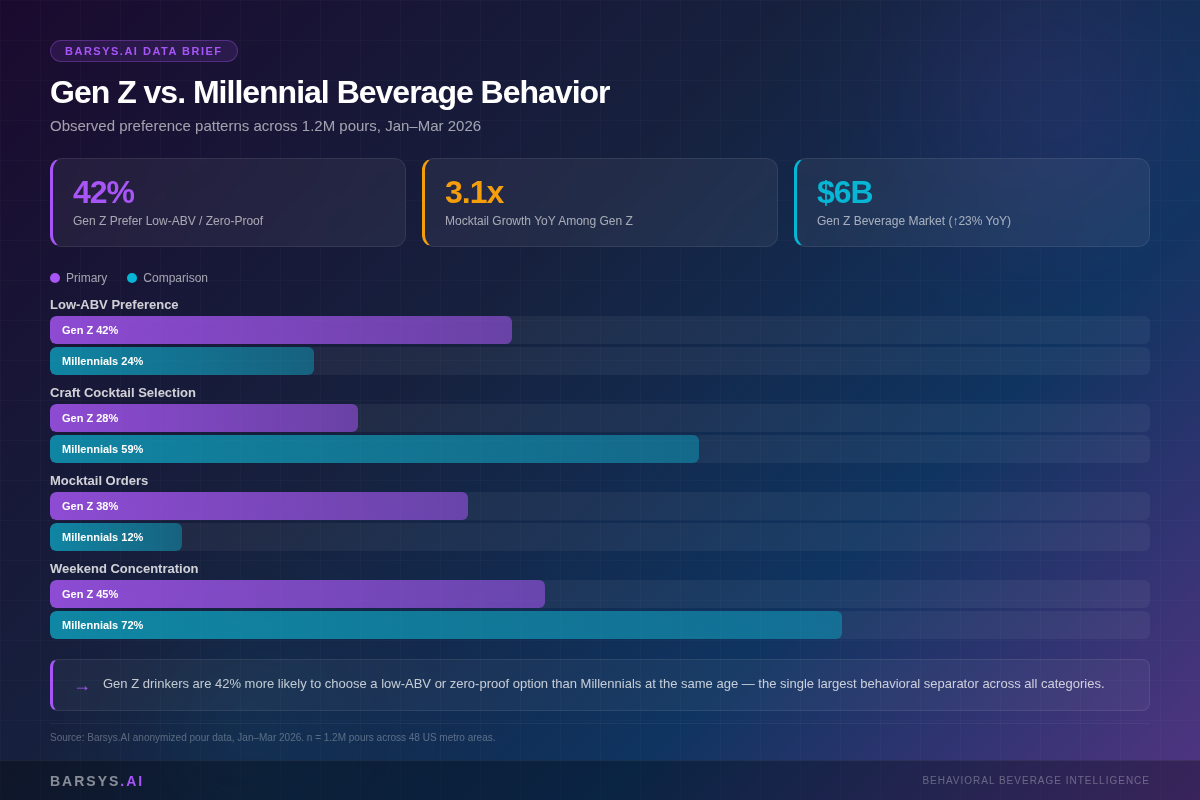
Among 21–26 year-olds, 42% of observed pours were low-ABV (under 10%) or zero-proof. Among 30–39 year-olds, that number drops to 24%. The gap is structural, not cyclical.
Millennials are still over-indexing on craft cocktails (+31% higher selection rate vs. Gen Z) and spirits exploration (+28% higher on whiskey, +19% higher on mezcal). But Millennials are also aging in place — their drinking occasions are concentrated on weekends, their category preferences are locked in, and their budgets are committed to established brands.
Gen Z is doing the opposite. Low-ABV and mocktail categories are growing 3.1x faster year-over-year among this cohort. More importantly: this isn't a side behavior. It's the default choice. On our platform, "low-ABV" has become the single largest search filter among 21–26 year-olds, used by 58% of users before they select a recipe.
Split #2: Aesthetics as a Category Driver
This is the split that catches most industry observers off guard.
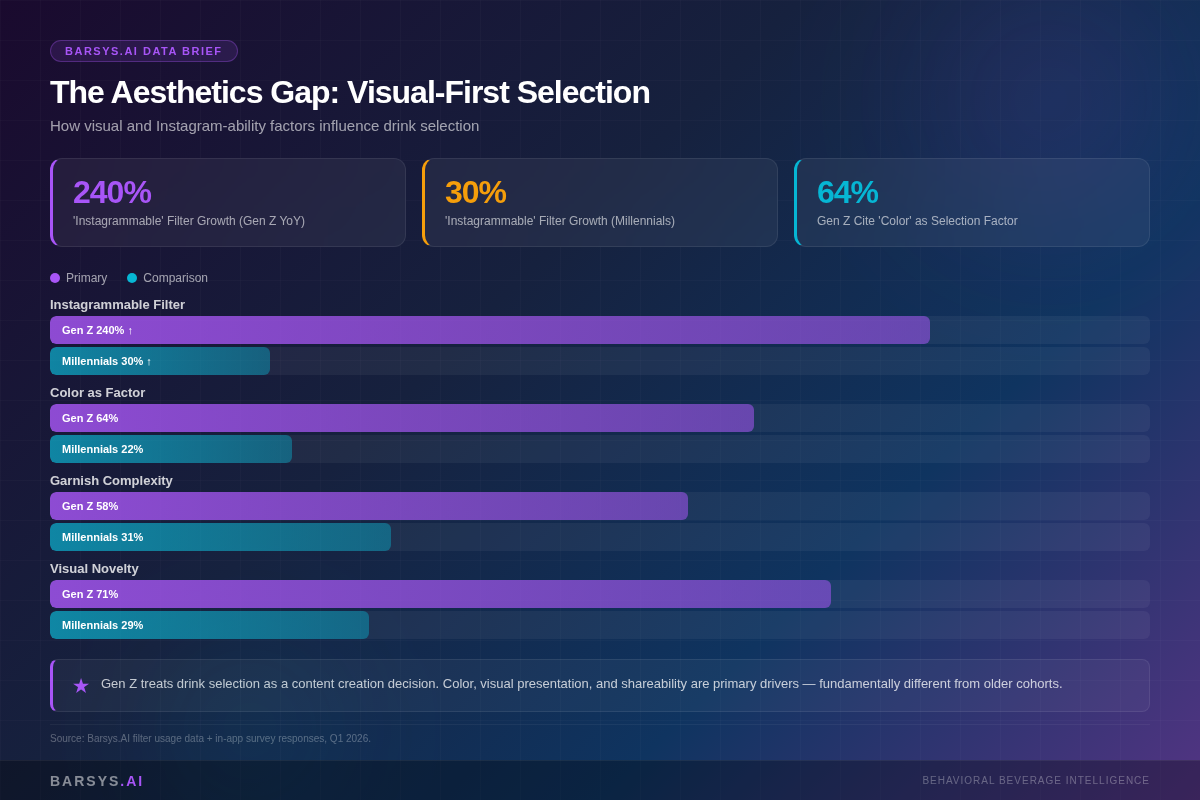
On our platform, Gen Z users have access to recipe filters for taste profile, ingredient, occasion, and dietary preference. But they're disproportionately using one filter: "Instagrammable."
The filter has grown 240% year-over-year among 21–26 year-olds — the fastest growth of any filter in our system. For Millennials, the same filter grew 30% YoY. The gap isn't small. The gap is structural.
What does "Instagrammable" mean in the recipe metadata? High visual contrast, bright colors, garnish complexity, and visual novelty. These are the drinks that photograph well. In Gen Z's decision process, "will this look good" is a primary filter — equal to or outweighing "what spirit do I want to drink."
Split #3: When They Drink (And Don't)
The final behavioral split emerges in consumption timing — and it's the most unexpected.
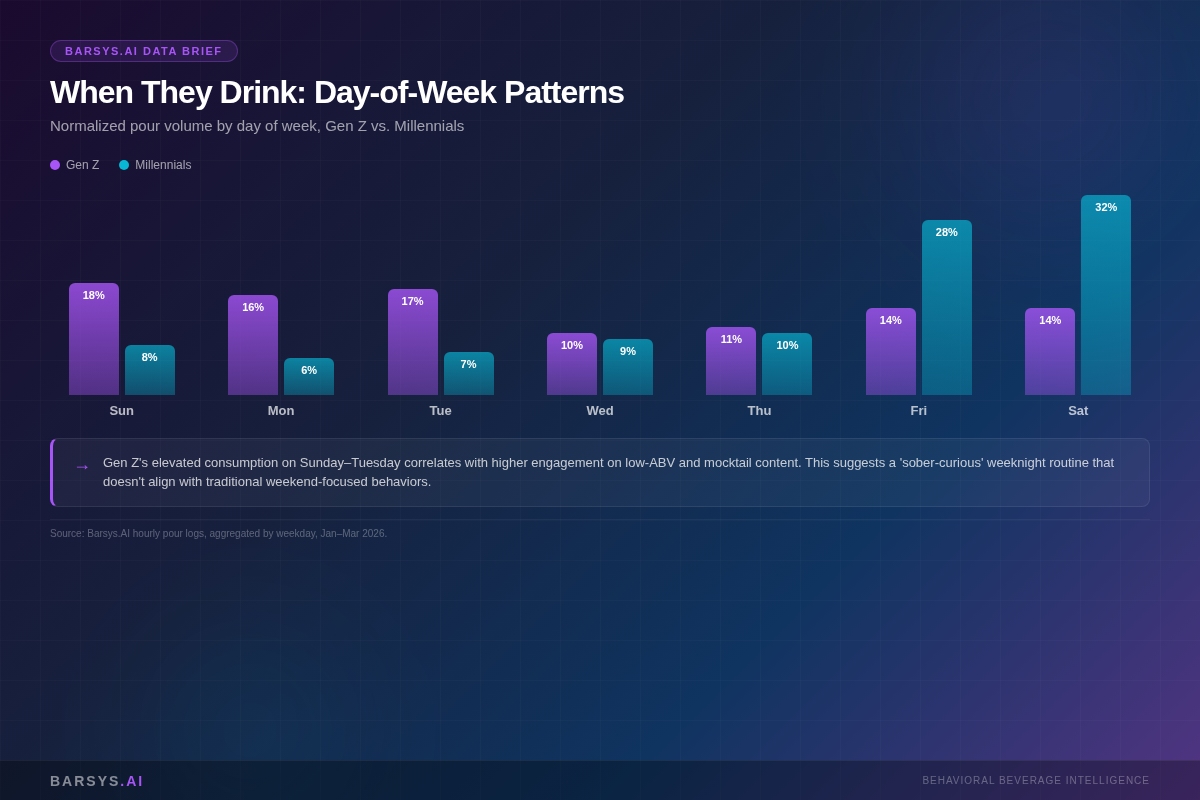
Millennials show the classic cocktail consumption curve: flat during weekdays, sharp spike on Friday and Saturday, drop on Sunday. Gen Z shows a different pattern. Their consumption is more distributed across the week, with peaks on Sunday, Monday, and Tuesday — not the weekend.
This timing pattern correlates with the sober-curious movement. Sober-curious content consumption peaks on Sunday, Monday, and Tuesday — the exact same days that Gen Z's low-ABV pours spike. The interpretation: A segment of Gen Z isn't "sober" — they're selectively sober during the week, choosing low-ABV or zero-proof options as a default. On weekends, they show higher ABV engagement, but still below Millennial rates.
What This Means for Brands
These three splits — ABV preference, aesthetics-first selection, and weeknight-focused timing — fundamentally reshape beverage brand targeting.
For spirits brands: Your Gen Z customer isn't the same as your Millennial customer. Millennials came to premium spirits through exploration and craft. Gen Z comes through aesthetics and occasion selection. Your media buying should shift toward weekends and late hours for Gen Z's higher-ABV moments.
For low-ABV and ready-to-drink brands: You have a structural tailwind. Gen Z's low-ABV indexing is 3x higher than Millennials at the same age. But you're competing on visual aesthetics, not just ABV. Your packaging and content strategy should center on shareability.
For mocktail and zero-proof brands: The 42% Gen Z engagement rate with zero-proof options isn't a niche — it's a primary market. Build your media strategy around weeknight occasions and social sharing.
The Bigger Picture
Gen Z isn't rejecting alcohol. They're rejecting the cultural assumption that drinking means high-ABV, weekend-focused, exploration-driven consumption. Instead, they're building a different model: strategic, visual, occasion-driven, and responsive to the workweek.
The brands that win with Gen Z won't be the ones that reduce ABV and hope. They'll be the ones that understand these behavioral splits and build products, media, and occasions around them. Aesthetics aren't a secondary consideration — they're the primary filter. Low-ABV isn't a compromise — it's a preference. And sober-curious isn't a trend — it's a timing pattern that reshapes the entire consumption calendar.
The data from our platform makes one thing clear: the generational divide in beverage consumption isn't about attitudes. It's about observed behavior. And that behavior tells a very different story than the one the industry has been telling.
See how brands are targeting Gen Z and Millennials differently on the Barsys network.
